Standby Power for Yakima Valley Homes: Interlock, Transfer System, or Battery Hookup
The right backup power setup depends on who's home, what has to keep running, and how much you want to do by hand.
October 6, 2026 · 3 min read
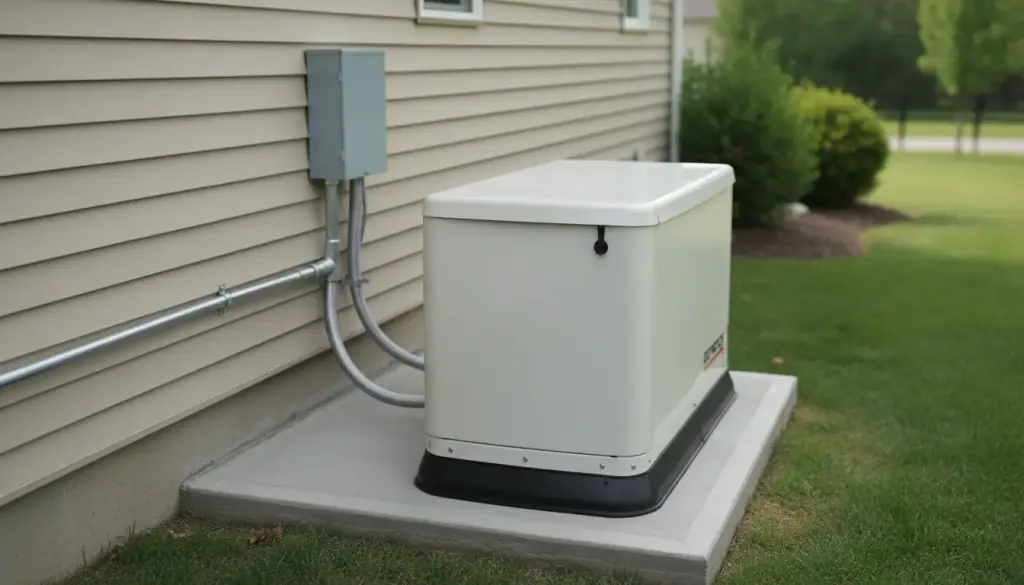
Anyone who has sat through a long winter outage in the valley knows the feeling. The furnace blower stops, the fridge starts to warm, and the phone battery becomes the most valuable thing you own. A generator or battery system fixes that, but only if it's connected to the house the right way. Here's how the main options work.
Why a generator can't just plug into the dryer outlet
You'll hear about homemade setups where a generator feeds the house through a cord with two plugs. Don't do it. Without a proper way to separate the house from the utility, power from your generator can flow backward onto the lines outside. That can seriously hurt a lineworker who thinks the line is dead. It can also damage your generator when utility power returns.
A real standby setup includes a way to keep your house and the utility apart. That's the whole job of the three systems below. And whatever you pick, never run a portable generator inside the house or the garage. Carbon monoxide doesn't care that the door is cracked.
Manual interlock
A manual interlock is a mechanical plate mounted on your panel. It makes it impossible for the main breaker and the generator breaker to be on at the same time. When the power goes out, you wheel the generator outside, plug it into an inlet on the house, start it, then flip the breakers in order.
This is the simplest of the three and the one that usually costs the least. It suits people who are home during outages and don't mind a short routine in the dark. You'll still need to choose which circuits to run, because a portable generator can't power everything at once.
One habit pays off with this setup. Do a dry run on a nice day, long before the storm. Wheel the generator out, hook it up, flip the breakers, and make sure you know where the fuel and the extension cords live. An outage at ten at night is a poor time to read the manual for the first time.
Automatic transfer system
An automatic transfer system watches the incoming power. When the utility drops out, it starts the generator and moves your circuits over by itself. When the utility comes back, it switches back. Nobody has to be home, and nobody has to find a flashlight.
That's the system for a household with someone who needs power around the clock, or one that's often away. It usually involves a permanent generator, which needs a fuel supply, and that side of the project is worth settling early.
Generator or battery hookup
Thunder Electric also lists generator and battery hookups as standby power work. The wiring can bring a generator or a battery bank into your existing panel. A generator runs as long as you have fuel. A battery is quiet and needs no fuel, but it only lasts as long as its stored capacity, so the size of what you want to run matters a lot. Either one can be a good fit. The right pick depends on how long your outages run and what's on your must-keep-running list.
Questions to settle before the estimate
- Which circuits can't go dark? Furnace, refrigerator, well pump, sump pump, medical equipment, internet.
- How long do you want to ride out an outage, a few hours or several days?
- Will someone always be home to start a generator, or does it need to start itself?
- What fuel do you want to deal with, or would you rather skip fuel and use a battery?
- Where will the equipment sit, and how far is that from the panel?
- Does your panel have room, or does it need work first?
Answering these before the estimate means the number you get back fits what you actually need.
Cost
Thunder Electric's standby power work starts at $750. Where your job lands depends on which system you pick and what the house needs, so the honest answer to "what will it cost" comes after someone has seen your panel. Financing through Wisetack is available for anything over $500, subject to credit approval, which can help when you're looking at an automatic system.
Standby power is easiest to plan when the lights are on. Call the office at (509) 575-8362, tell them what has to keep running, and they can point you to the setup that fits. And if the lights are already out and something looks wrong with the house wiring itself, the 24/7 emergency line will get you to the on-call tech.
Thunder Electric, (509) 575-8362
Call (509) 575-8362More articles
Breaker Keeps Tripping or Outlets Went Dead? What to Check First
Some trips are harmless and some are a warning, and a few safe checks will tell you which one you've got.
Signs Your Electrical Panel May Need Replacing, and Why a Second Opinion Pays
A panel replacement is a big number, so make sure the problem really is the panel.